Last updated October 15, 2026
DIY vs Professional ADU: The Riverside Homeowner’s Decision Guide
Here’s something most ADU guides won’t tell you: the biggest cost difference between building it yourself and hiring a pro in Riverside isn’t labor, it’s liability. California’s owner-builder exemption lets you pull your own permits, sure. But it also makes you personally responsible for code violations for up to 10 years after the home is sold. Riverside’s Building & Safety office requires owner-builders to attest in writing that they understand this before a permit gets issued. Most homeowners sign that form without fully grasping what it means. This guide walks through both paths, the real numbers, and the three questions that tell you which route actually fits your situation in Riverside.
Quick Answer
For most Riverside homeowners, hiring a licensed ADU builder costs $280 to $450 per square foot all-in and takes 6 to 10 months from permit to occupancy. Going the owner-builder route can save 10 to 20 percent, but you’ll spend 200 to 400 hours managing the project and carry personal liability for code compliance for a decade after you sell. DIY makes sense only for finish work after the permit is issued, not for foundations, framing, electrical, plumbing, or roofing.
Table of Contents
- What California Law Actually Allows an Owner-Builder in Riverside
- The Real Cost of Owner-Builder Project Management in Riverside
- Where DIY Genuinely Saves Money vs Where It Creates Liability
- Insurance and Resale: What an Owner-Builder ADU Means in Riverside
- The Prefab Option: A Middle Path Worth Understanding
- Three Questions That Tell You Which Path Fits
- The Hidden Timeline: How Delays Compound in Riverside
- Who Does What: Trade-by-Trade Breakdown for Owner-Builders
What California Law Actually Allows an Owner-Builder in Riverside
California Business & Professions Code Section 7044 creates the owner-builder exemption. It lets a homeowner act as their own general contractor for work on their primary residence, provided they plan to occupy the home for at least 12 months after completion. That’s the legal framework. But the exemption does not let you perform every trade yourself. Electrical work, for instance, requires a C-10 licensed electrician in most California jurisdictions, including Riverside. Plumbing requires a C-36. HVAC requires a C-20. Structural engineering sign-off requires a licensed civil or structural engineer, period.
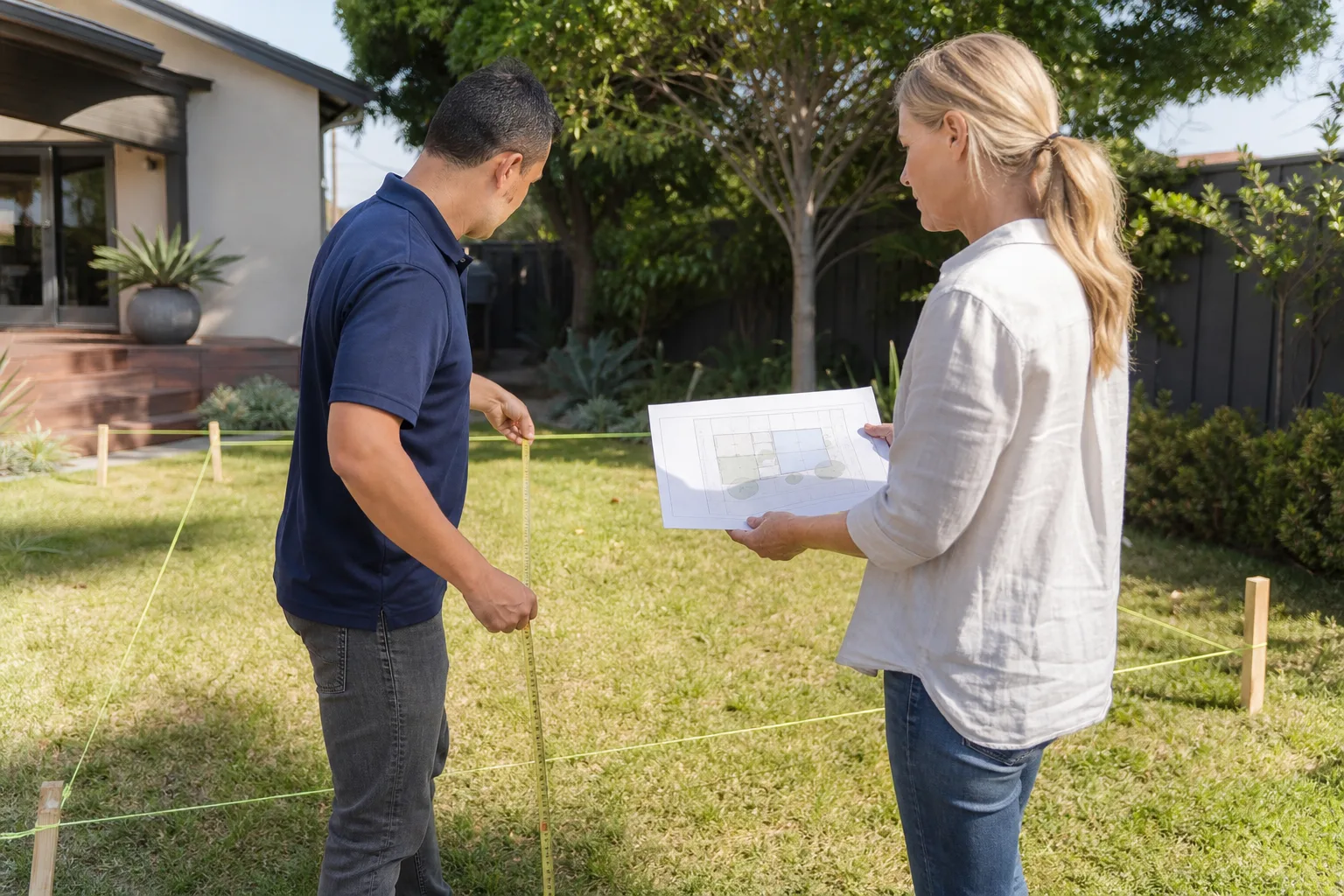
What you can self-perform without a license includes: interior painting, trim carpentry, flooring installation, cabinet installation, landscaping, and most demolition. You can also pull the master permit and manage licensed subcontractors yourself. That’s the actual scope of the owner-builder path in Riverside. You’re not building the walls. You’re hiring and coordinating the people who build them.
Riverside’s Building & Safety division has its own requirements layered on top of state law. Owner-builders must file a “Verification of Owner-Builder Status” form and sign a disclosure acknowledging they understand the liability. The disclosure specifically covers the 10-year defect disclosure window under California Civil Code Section 896. When you sell your Riverside home after an owner-builder ADU, you must disclose that fact on the Transfer Disclosure Statement. Buyers and their lenders react to that disclosure in ways we’ll get into below.
That matters. In our experience, most Riverside homeowners who choose the owner-builder path don’t actually want to swing hammers. They want to save the 15 to 25 percent general contractor markup. The law allows that. But it assigns you every responsibility the GC would have carried, including the legal ones.
The Real Cost of Owner-Builder Project Management in Riverside
Here’s the number competitors rarely publish: a typical detached ADU in Riverside requires 200 to 400 hours of active project management when you’re the owner-builder. That’s 5 to 10 full work weeks, spread across 9 to 14 months. If your time is worth $40 an hour, that’s $8,000 to $16,000 in uncompensated labor. If your time is worth $75 an hour, it’s $15,000 to $30,000. The general contractor markup you’re trying to save is typically 15 to 20 percent of a $180,000 to $350,000 project, or $27,000 to $70,000. On paper, owner-builder wins if you manage well. In practice, the costs of mistakes at inspection stages often narrow that gap substantially.
Riverside’s inspection schedule punishes errors in sequence. A foundation inspection failure pushes back framing. A framing inspection failure pushes back rough electrical and plumbing. A rough-in failure pushes back insulation and drywall. Each failed inspection costs you the fee for the re-inspection plus the days of idle subcontractors. Subcontractors don’t absorb those delays; you do. A single missed call on a framing detail can cost $1,500 to $4,000 in rescheduling and material rework when it fails.
What often goes overlooked: owner-builders pay higher sub quotes than repeat GCs. A framing crew that regularly works with the same general contractor knows the job flow and prices accordingly. The same crew quoting an unknown owner-builder in Riverside will often add 10 to 15 percent to cover the risk of working with someone who may not coordinate cleanly. That’s not greed. That’s the market pricing uncertainty. The result: your theoretical savings get eaten at the bid stage before you’ve done anything wrong.
The time audit matters more than most people admit. Every trip to the permit office in downtown Riverside, every unanswered call to a concrete sub, every evening spent re-reading the California Residential Code section on egress windows: that’s time you’re not earning your regular income or being with your family. For a two-income household in Riverside, that’s the real trade.
Where DIY Genuinely Saves Money vs Where It Creates Liability
Let’s be clear about where owner involvement actually helps. The highest-value DIY work on an ADU in Riverside happens after the building is dried in and passed its rough inspections. Finish carpentry, interior painting, flooring, trim, closet systems, landscaping, and hardscape all fall in this category. These tasks carry low code risk, don’t require licensed trades, and don’t sit on the permit’s critical path. You can paint an ADU interior in three weekends. You can install LVP flooring in four days. You can save $8,000 to $15,000 doing finish work yourself with almost zero additional legal exposure.
Here’s where DIY hurts: anything involving load, water, fire, or current. Foundations are structural. Framing is structural. Roofing protects the envelope. Electrical carries fire risk. Plumbing carries water intrusion risk. HVAC carries combustion risk. Each of these is a licensed trade in California for a reason. And each failure becomes your personal liability on an owner-builder permit. The electrical panel upgrade that powers your ADU? That’s a C-10 job in Riverside. Your DIY panel wiring that passes your uncle’s glance but fails the city inspection isn’t just a cost problem; it’s a code violation on record with the city.
The line between “saves money” and “creates liability” in Riverside sits exactly at the permit-critical path. If an inspector looks at it, a licensed trade should have done it. If no inspector looks at it, DIY is genuinely smart. Painters don’t get inspected. Electricians do.
One more area worth naming: design and drafting. Some homeowners think they’ll save money sketching their own plans. Riverside’s plan review process requires stamped engineering for nearly all ADU structures, whether it’s a garage conversion or a new detached build. A draftsman who knows the Riverside planning department’s expectations can save you two or three resubmission cycles. That’s a place where paying a professional, even on an owner-builder project, is close to free compared to the cost of resubmission delays.
Insurance and Resale: What an Owner-Builder ADU Means in Riverside
Your homeowner’s insurance policy likely covers DIY work on your home while it’s being built, but the moment the structure becomes a rental or a dwelling unit, the risk profile changes. A Riverside homeowner with a permitted, professionally built ADU typically adds an endorsement to their policy for the accessory structure and any rental activity. That’s often $400 to $900 a year. An owner-builder ADU doesn’t automatically cost more to insure, but many carriers will ask for documentation: final inspection sign-off, proof of licensed trade work on electrical and plumbing, and sometimes an engineer’s letter for the foundation. If you can’t produce those records, some carriers decline to endorse the coverage at all. The ADU becomes a coverage gap you discover when you need it.
Resale is where the owner-builder decision really compounds. California law requires you to disclose that the ADU was built under an owner-builder permit. Disclosing isn’t a deal-breaker, but it changes the buyer’s due diligence. A buyer represented by a sharp agent, and that’s most buyers in Riverside’s current market, will request receipts for every trade, copies of every inspection pass, and possibly a structural engineer’s review at your expense. A professionally built ADU from a company like Lodgewick ADU Riverside home comes with a permit file and workmanship warranty that answers those questions in a folder. An owner-builder ADU comes with whatever records you kept.
Appraisers don’t care who built the ADU. They care that it’s permitted and meets lending standards. But underwriters do care. FHA and VA loans have specific requirements about accessory dwelling units. A permitted ADU with licensed trade sign-offs clears those requirements without drama. An owner-builder unit with gaps in the paper trail can stall an escrow. In a market where Riverside homes with ADUs command $100,000 to $250,000 more than comparable homes without them, that stall has a dollar value.
The 10-year liability under California Civil Code 896 isn’t theoretical. If you sell your Riverside home in year six after building an owner-builder ADU, and the buyer discovers a structural defect in year seven, you can be named in the claim. A professionally built ADU carries the contractor’s workmanship warranty, and in California, contractors carry 10-year structural liability under the Right to Repair Act. Your insurance policy won’t cover a construction defect claim. The contractor’s will. That’s the difference between delegating risk and absorbing it.
The Prefab Option: A Middle Path Worth Understanding
Between full DIY and full custom build sits an option that Riverside homeowners don’t consider often enough: prefabricated ADUs. Companies like Abodu and Cover build ADU modules in factories and crane them onto your foundation, typically in one to three days of on-site assembly. The factory controls framing tolerances, insulation consistency, and drywall quality in ways that site-built construction, even by good crews, can’t always match. A Tuff Shed structure, by contrast, starts as a shell; finishing it into a legal dwelling unit requires insulation, electrical, plumbing, a foundation, and a full Riverside permit.
Prefab isn’t a license to skip trades. The foundation still gets poured by a concrete contractor. The electrical service still gets connected by a C-10 electrician. The site work, drainage, and landscaping still happen in Riverside’s clay-heavy soil, which means geotechnical considerations and possibly deeper footings than a standard plan set assumes. What prefab removes is most of the framing-stage variability and about 60 to 90 days of construction timeline versus a site-built ADU.
Owner-builders sometimes combine paths: they handle the site work and finish trades themselves, while the prefab company handles the module and a GC handles the utility connections. That hybrid approach can save real money, but it also slices the accountability into three pieces. If the foundation settles, it’s the concrete sub’s problem. If the factory module has a seam leak, it’s the prefab company’s problem. If the final inspection fails, it’s yours. You need to be very clear-eyed about who owns which failure before signing any of those three contracts.
For Riverside homeowners exploring a home addition alongside or instead of an ADU, the same middle path exists. You can hire licensed trades for the permit-critical work and take on the finish work yourself. The principle holds across project types: delegate what carries liability, self-perform what carries only sweat equity.
Three Questions That Tell You Which Path Fits
We’ve watched both paths play out across dozens of Riverside ADU projects. The homeowners who succeed as owner-builders share three traits: they have a flexible schedule that can absorb 10 to 20 hours a week for a year, they have prior construction-adjacent experience (a father who was a contractor, a past renovation they managed, a job in engineering or architecture), and they have a high tolerance for phone calls, scheduling hiccups, and trade personalities. If that’s not you, that’s not a failure of character. That’s just information.
Here’s the decision framework. Three questions. Answer honestly.
- Can you absorb 10 to 20 hours a week for 9 to 14 months without damaging your main income? If your hourly compensation exceeds roughly $60, the GC fee is cheaper than your time. Most Riverside professionals earn more than that.
- Do you know, right now, what a clean framing inspection looks like? If you can’t answer what “blocking at 4 feet on center for drywall backing” means, you’ll learn on the job at your own inspection-failure expense. Learning is valuable. Learning at $400 per rescheduled trade crew day is expensive.
- Can you hold liability comfortably for a decade after sale? If the phrase “10-year structural defect liability” makes you pause, you’ve already answered. And that’s fine. Most people should not carry structural liability for a building they didn’t have engineered and built by licensed trades.
If you answered “no” to any of these, the professional path isn’t a luxury; it’s the rational choice. The owner-builder route is for people whose time is cheap, whose construction knowledge is real, and whose risk tolerance is high. Riverside has those people. They build good ADUs. But they’re the minority, and pretending otherwise costs money.
The Hidden Timeline: How Delays Compound in Riverside
Every ADU project in Riverside faces the same permitting clock. Plan review runs 4 to 8 weeks at Riverside’s Building & Safety division. Corrections and resubmissions add 2 to 4 weeks per cycle. Permitting gets issued. Then construction starts, and the inspection schedule governs everything. A professionally managed project sequences trades so each inspection passes the first time, or fails on a minor correction with the inspector returning within days. An owner-builder project sequences trades around the owner’s availability, and the owner’s learning curve becomes the bottleneck.
We’ve seen the compounding effect in specific Riverside neighborhoods, from the Wood Streets to Canyon Crest to La Sierra. A two-week delay in window delivery pushes framing inspection back three weeks because the window supplier’s next installation crew is booked. That pushes rough electrical inspection back. That pushes drywall back. That pushes the final inspection into the next city cycle. A $200 window becomes a $3,500 schedule cascade.
Professional builders carry the one asset owner-builders rarely have: a standing trade network. The framer who works with the same GC four months a year will answer the phone differently than he answers an unknown homeowner’s call. That’s not favoritism. That’s repeat business economics. It shapes timelines in ways that don’t appear in any budget spreadsheet.
Riverside’s climate adds a specific wrinkle worth naming. Summer heat in the Inland Empire, regularly above 100 degrees from July through September, slows exterior concrete and roofing work. Winter rains, concentrated in January and February, stall foundation pours and trenching. A project that starts in October hits the rainy season at the worst possible moment: either the foundation goes in before the rains or it waits until March. Professional scheduling plans around these windows. Owner-builder scheduling discovers them by surprise.
Who Does What: Trade-by-Trade Breakdown for Owner-Builders
This is the section nobody writes, and it’s the one Riverside owner-builders most often ask us for. If you’re pulling your own permit, here’s the trade-by-trade reality of what you can and cannot legally self-perform in California. This isn’t a recommendation. It’s the statute.
- Site preparation and grading: You may self-perform if you rent equipment and understand drainage. Riverside’s expansive clay soils argue for a geotechnical report before you grade anything. Most homeowners skip the geo report exactly once.
- Foundation and concrete: You may self-perform under the owner-builder exemption, but engineered plans are mandatory. Pouring a foundation that an engineer signed off on, then having it fail inspection, is your risk. Concrete is unforgiving; you get one pour.
- Framing: You may self-perform. This is where most owner-builders lose the most money. A Riverside inspector who finds a single noncompliant shear wall detail will fail the framing inspection, and you’ll spend two weeks and $2,000 fixing it.
- Electrical: You may not self-perform in California unless you hold a C-10 license or are a licensed electrical contractor. Riverside requires a licensed electrician for service panels, wiring, and fixtures. The owner-builder exemption does not override trade-specific licensing in this state.
- Plumbing: Same rule. C-36 required. The owner-builder exemption covers project management, not performing licensed trades. A Riverside inspector will check the plumber’s license on a permitted ADU.
- HVAC: C-20 required. You also need a Manual J load calculation. Most owner-builders don’t know what a Manual J is until the plan reviewer asks for one.
- Roofing: You may self-perform, but a Riverside roof on a dwelling unit must meet Title 24 cool roof requirements. The wrong shingle color fails energy compliance. And working at height is where serious injuries happen; if you’re not experienced on a roof, this is the trade to delegate.
- Drywall, taping, paint, trim, flooring, cabinets: All self-performable. This is the money-saving zone. No license requirements, no inspection on the finish trades.
- Final punch and sign-off: Yours if you’re the owner-builder. Every correction requested by the inspector, every re-inspection booking, every call to the Riverside Building & Safety office: your time.
The pattern is obvious once you see it. The trades that carry the most risk (electrical, plumbing, HVAC) are legally off-limits to unlicensed self-performers. The trades most likely to fail inspection (framing, concrete, roofing) carry the heaviest rework costs. The trades where DIY truly works (finish work) are the same ones you can do after the permit is closed or while the licensed trades finish their inspections. It’s possible to run an owner-builder project where you self-perform only the smart things. Most people don’t, because they didn’t know the breakdown before they started.
Common Mistakes to Avoid
- Underestimating the work weeks involved. The 200 to 400 hours aren’t spread evenly; they cluster during permit review, before inspections, and during the punch list. A Riverside homeowner with a full-time job hits those clusters at the worst times.
- Skipping the geo report. Riverside’s clay soil expands and contracts. The city won’t force you to get a geotechnical report, but an engineer’s foundation design without one is a guess. Failed foundations are the most expensive failure an ADU can have.
- Paying subcontractors in full before the inspection passes. The standard is progress payments with a retainage until final sign-off. First-time owner-builders often pay early out of good faith. Then the sub stops answering calls.
- Not checking license status. Riverside requires proof that any licensed trade on your owner-builder permit actually holds the license. Hiring an unlicensed “electrician” who fails inspection leaves you with the code violation on your record, not his.
- Building before the permit is issued. This seems obvious, but it happens. A homeowner starts a garage conversion, begins demolition, and then applies for the permit. Riverside sees this often. The fix is a stop-work order and sometimes a fine.
- Choosing the cheapest plan draftsperson. Plans that don’t pass Riverside plan review cost you a resubmission cycle each time. Three cycles can add 3 months. Good plans from someone who knows the city’s reviewers are worth every dollar.
- Ignoring the resale disclosure timing. You’ll sign the owner-builder disclosure at permit issuance. You’ll answer for it again at sale. The liability doesn’t expire when the final inspection passes. It follows the home for 10 years.
When to Call a Professional
Call a professional when the project involves the permit-critical path and you can’t absorb the time to manage it properly. That’s most ADU projects. If your ADU includes a second story, sits on a sloped lot, connects to an existing structure, or requires a main panel upgrade, you’re past the point where owner-builder risk is worth it. Also call when the answer to any of the three framework questions above was no. ADU Builders in Riverside who carry license, insurance, and a written workmanship warranty take the liability off your shoulders for the decade it matters. Lodgewick ADU Riverside offers free estimates in Riverside. Call (831) 292-4191 to walk through your site, your budget, and which path honestly fits your situation.
Frequently Asked Questions
A permitted ADU in Riverside typically costs $280 to $450 per square foot for a site-built unit, meaning a 600-square-foot one-bedroom ADU runs roughly $170,000 to $270,000 all-in. Garage conversions run slightly lower per square foot, often $220 to $350, because the shell already exists. Prefab ADUs from companies like Abodu or Cover typically land in the $250 to $400 per square foot range once site work, foundation, and utility connections are included. Call (831) 292-4191 for a written estimate specific to your Riverside lot.
Yes, California’s owner-builder exemption allows Riverside homeowners to pull their own permits and act as their own general contractor, provided they live on the property for at least 12 months after completion. But the exemption does not let you self-perform licensed trades like electrical, plumbing, or HVAC, and it makes you personally liable for code violations for up to 10 years after sale.
A professionally managed ADU in Riverside takes 6 to 10 months from permit application to final inspection, with plan review consuming 1 to 3 months of that. Owner-builder projects typically take 9 to 14 months because the homeowner’s schedule, not the trade schedule, becomes the pacing constraint. Prefab ADUs can shorten the construction phase by 2 to 3 months but still face the same Riverside permitting timeline.
Yes. Painting, trim, flooring, cabinets, landscaping, and hardscape are all self-performable and carry no licensing requirement. This is where DIY genuinely saves money: expect $8,000 to $15,000 in savings on finish trades without adding legal exposure. Just don’t start finish work before the relevant inspections pass.
Yes, but not based on the full market value. California bases the property tax increase on the added value of the ADU construction cost. A $200,000 ADU in Riverside adds roughly $2,000 to $2,500 per year to your property tax bill at Riverside County’s effective rate, plus any local assessments. The increase is triggered by the final inspection, not by the date you pull the permit.
Your insurer will likely cover an owner-builder ADU after final inspection if you can produce proof that licensed trades performed the electrical, plumbing, and HVAC work, and that the structure passed all Riverside inspections. Without that documentation, some carriers decline to endorse the policy. A professionally built ADU typically comes with the paper trail insurers and future buyers want to see.
Yes. Riverside requires ADUs to have a separate address for emergency response, utility metering, and mail delivery. The address is assigned during the permit process. If your ADU is a garage conversion, the new address replaces the garage’s old utility designation. This is handled by the city, not by your choice of builder.
The Bottom Line
The DIY-vs-hire decision for a Riverside ADU is less about construction skill than about what you legally can self-perform, what you actually have time to manage, and how much liability you’re willing to carry for a decade after the sale. Owner-builder works for a small subset of homeowners: those with time, construction literacy, and risk tolerance. For everyone else, hiring licensed professionals costs more upfront and less in the long run once you factor in the value of your own time, the cost of inspection failures, and the liability transfer that comes with a contractor’s warranty. Riverside gives you the legal right to build it yourself. That doesn’t mean it’s the smart choice. Get a written estimate, compare it against a realistic owner-builder budget including your own hours, and let the numbers decide. Lodgewick ADU Riverside offers free estimates. Call (831) 292-4191 to start with a real number on paper.
Written by Russ Delmar, Owner at Lodgewick ADU Riverside, serving Riverside since 2010.