James Hardie ADU Design & Permitting: The Riverside Owner’s Guide
James Hardie siding and trim on an ADU in Riverside typically runs $14,000 – $38,000 installed, with design and permitting adding $4,500 – $9,500 depending on lot conditions and plan complexity. We stock HardiePlank lap siding, HardiePanel vertical siding, and HardieTrim boards on the truck for most ADU sizes, and we can usually get a full materials list priced within two business days of a site visit. The most common call we get starts the same way: a homeowner got halfway through a garage conversion, the previous contractor ghosted, and now the city is asking for revised plans and the exposed siding is warping at the bottom edge because it was installed too close to grade.
Here’s what you need to know before you spend another dollar: James Hardie products have specific installation clearances and fastener schedules in Riverside’s climate zone, and getting that wrong voids the manufacturer warranty and fails city inspection. We fix that. Russ Delmar and our crew have pulled more than a few permits off the shelf where the previous submission was rejected for exactly that reason.
Which James Hardie Models This Applies To
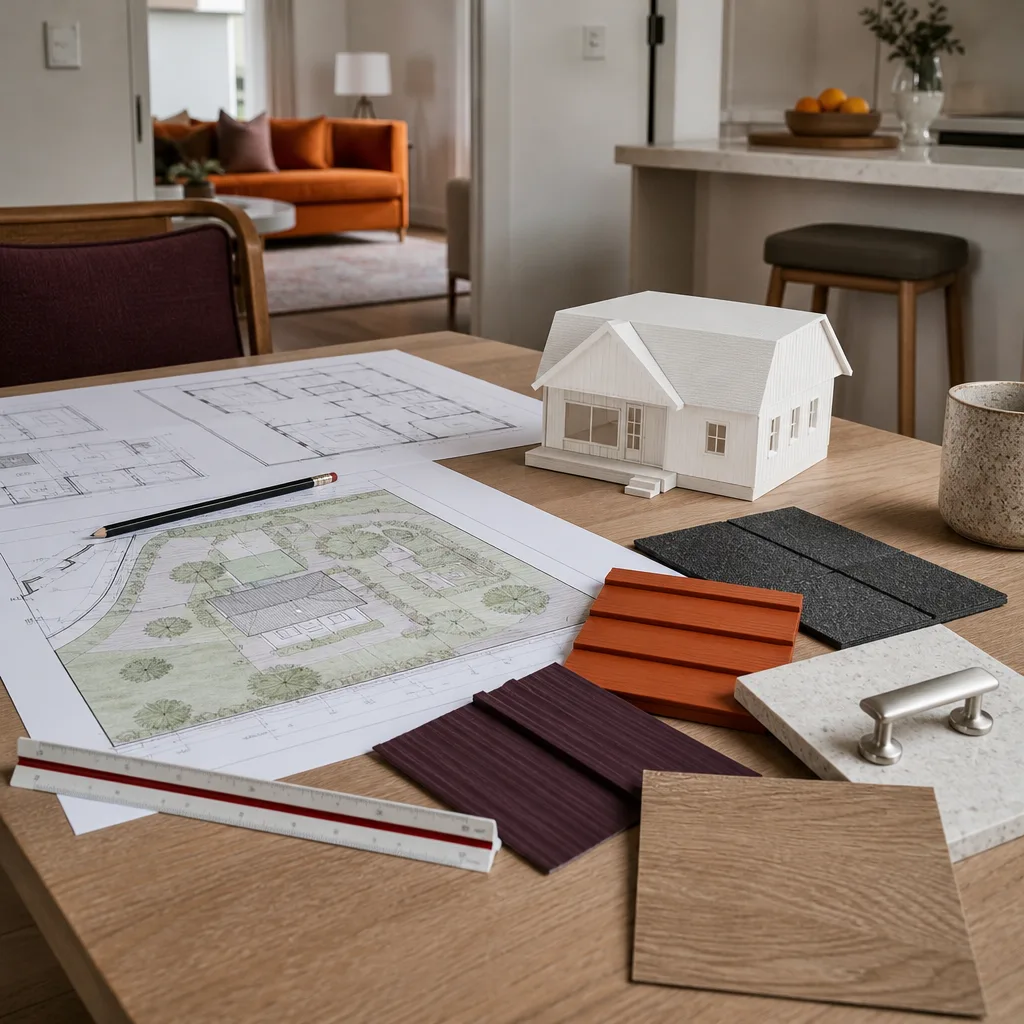
We work with the full James Hardie residential line for ADUs in Riverside: HardiePlank HZ5 lap siding, HardiePanel HZ5 vertical siding, HardieTrim HZ5 boards, and HardieSoffit panels. The HZ5 designation matters. It’s the formulation rated for Riverside’s heat and UV exposure, and it has a different expansion and moisture profile than the HZ10 product made for wetter, cooler climates. If someone installs HZ10 out here to save a few hundred dollars, you’ll see joint separation within two summers.
Identifying what you have is straightforward. HardiePlank boards are stamped on the back face with the product name and HZ5 designation. HardieTrim boards have a smooth, primed face and a 5/4 thickness dimension, which is a quarter inch thicker than the lap siding. If you’re matching existing siding on an ADU that’s already partially built, measure the exposure (the visible height of each lap board). Riverside ADUs we’ve worked on near the Mission Inn district typically use a 5-inch or 6-inch exposure, and getting that wrong means your patches won’t line up.
On the OEM versus aftermarket question: James Hardie does not license third-party equivalents for their fiber cement products. There are generic fiber cement sidings on the market, but they don’t carry the same 30-year non-prorated substrate warranty, and mixing them on one ADU wall creates a color and texture mismatch city inspectors will flag. We install genuine James Hardie product, period. That’s the only way the warranty holds.
Signs Your James Hardie ADU Design & Permitting Is Failing
- Warping or buckling at the bottom 6 inches of siding. James Hardie requires a minimum 6-inch clearance from grade to the bottom edge of siding. When it’s installed too low, Riverside’s dry-wet-dry soil cycle wicks moisture up into the board, and it cups. This is a code violation and a warranty killer.
- Visible joint separation between boards. HardiePlank is engineered to move slightly with temperature shifts. If butt joints were nailed too tight or the wrong gauge flashing was used, Riverside’s 100-degree summer days will open those joints up. You’ll see gaps appear in August that mostly close by January, but each cycle lets water behind the board.
- Caulk cracking around windows and trim boards. Hardie installation requires a specific joint treatment: either caulk at trim transitions or a HZ-compatible flashing system. Generic silicone caulk fails within 18 months in Riverside sun. We use the manufacturer-specified sealant, which holds for the life of the paint cycle.
- City corrections on an existing permit. If Riverside’s building department has issued a correction notice on your ADU plans citing siding fasteners, shear nailing patterns, or trim attachment, that’s a design-and-permitting failure. It means the original plans weren’t drawn to James Hardie’s published engineering data. We redraw and resubmit those corrections weekly.
- Paint failing on one wall but not the others. Hardie siding is factory-primed and must be top-coated within 180 days. If one elevation is peeling while the others hold, that wall was likely installed months before the rest, or it was exposed to weather before paint went on. Either way, the fix is new board on that elevation.
Replacement Cost & What’s Included

For a standard 400 – 600 square foot ADU in Riverside, expect to pay:
- Full siding replacement (HardiePlank HZ5, primed): $8,500 – $14,000 installed
- Partial siding repair (one or two elevations): $2,800 – $5,500 installed
- Trim and soffit replacement: $1,800 – $3,400 installed
- Design and permitting package (new ADU): $4,500 – $9,500
- Permit correction and resubmission only: $1,200 – $2,800
The range comes down to access, existing framing condition, and whether the old siding was installed over a code-compliant weather barrier. We write the price before we start, and that number doesn’t move. Every project gets the 365-Day Done Right Promise in writing: if the installation fails within a year, we come back and make it right at no charge. That’s how The Kingswell Way works on every job.
DIY or Call Us?
You can safely check a few things yourself: measure your siding clearance from grade, look for visible joint gaps, and confirm whether your boards are stamped HZ5. That information helps us quote accurately over the phone. What you should not do is pull off damaged fiber cement board yourself. James Hardie products contain silica, and cutting or breaking them creates respirable dust that’s a known respiratory hazard. Proper handling requires HEPA-equipped tools and the right personal protective equipment. Beyond that, fiber cement is brittle; a homeowner with a pry bar usually breaks more boards than they save.
If the issue is a failed permit or a rejected plan set, that’s not a DIY project at all. Riverside has specific requirements for ADU siding attachment in high-wind zones and seismic detailing on two-story units. If the plans don’t show the correct nailing pattern for HardiePlank per the manufacturer’s engineering report, the permit dies on the plan checker’s desk. We fix those submissions, and we do it for less than a full redesign because we’re starting from your existing drawings. Call us at (831) 292-4191 and we’ll walk you through what you have and what it needs.
FAQs
James Hardie HZ5 siding carries a 30-year non-prorated substrate warranty, and with correct installation and a repaint every 10 – 12 years, we’ve seen it perform that long in Riverside’s climate without issues. The failure points we see are installation errors, not product fatigue: insufficient clearance from grade, wrong fasteners, or missing flashing at penetrations.
Individual boards can be replaced if the damage is isolated to one or two courses and the underlying weather barrier is intact. If the damage is widespread or the original installation didn’t meet James Hardie’s published clearances and fastener schedules, a full replacement on that elevation is usually cheaper long-term. Call (831) 292-4191 and we’ll give you an honest read.
A full siding replacement on a standard Riverside ADU takes 5 – 8 working days, including tear-off, weather barrier inspection, new Hardie board installation, and trim. If we’re also handling plan corrections and permit sign-off, the paperwork moves on its own timeline with the city, but the field work doesn’t start until the permit is approved.
We keep standard HardiePlank HZ5 lap siding in 5-inch and 6-inch exposures, HardiePanel, and HardieTrim in our Riverside yard, along with the manufacturer-specified fasteners, flashing, and sealants. Custom color or texture profiles are ordered direct from James Hardie and usually arrive within 5 – 7 business days. If the number isn’t on the page, it isn’t a real quote; call us for a written price on your specific ADU.
Written by Russ Delmar, Owner, Lodgewick ADU Riverside at Lodgewick ADU Riverside, serving Riverside and nearby areas.